Category: On-Page SEO

  • On-Page SEO Best Practices for 2026: A Practical Checklist

    On-Page SEO Best Practices for 2026: A Practical Checklist

    If you want more traffic from Google without waiting on backlinks or a site redesign, on-page SEO is usually where you get the fastest compounding wins. It’s the work you do on a single page to help search engines understand it, help users trust it, and help it work well on mobile.

    A consistent process gets easier with Supawriter: you can generate long-form pages in your brand voice, get built-in SEO help (meta tags, internal linking suggestions, structure), and publish on a schedule without turning your team into a content factory.

    What on-page SEO is and what it includes in 2026

    On-page SEO is optimizing a webpage’s content and HTML elements so it can rank for relevant searches and earn clicks once it shows up. In 2026, the definition hasn’t changed much, but expectations have: pages need to match intent, be easy to scan, and load and behave well.

    On-page vs. technical vs. off-page SEO

    • On-page SEO: what’s on the page (content, headings, title tag, internal links, images, schema on that URL).
    • Technical SEO: sitewide foundations (crawlability, indexing, rendering, site architecture, performance tooling).
    • Off-page SEO: signals outside your site (links, mentions, brand demand).

    They overlap, but when you’re improving one specific URL, your biggest levers are usually on-page.

    What’s changed in 2026: intent, UX, and AI visibility

    Search results aren’t just 10 blue links anymore. Google shows more rich features, and AI tools pull sections of pages to answer questions. Clear structure and self-contained answers make it easier for both people and machines to use your content.

    Semrush notes that on-page SEO now includes improving visibility in search results and in responses from large language model tools, by using clear headings, internal links, and strong page experience. (Semrush on-page SEO guide)

    The 80/20: fixes that usually move rankings fastest

    If you only have time for a few improvements, start here:

    1. Match intent (your page must solve the problem the query implies)
    2. Upgrade the title tag (better relevance and CTR)
    3. Fix heading structure (scannable sections that answer questions)
    4. Strengthen internal links (help Google and users discover related pages)
    5. Improve page experience basics (mobile usability and Core Web Vitals)

    On-page SEO checklist (the essentials)

    Use this checklist every time you publish a new page or refresh an existing one.

    Pick one primary keyword and map search intent

    Pick one primary keyword per page and write the page to satisfy that query. Then add a small set of closely related secondary terms that naturally fit your sections.

    A quick intent test:

    • If the SERP is mostly guides, your page should be educational and comprehensive.
    • If it’s mostly product pages, your page should be transactional and comparison-friendly.
    • If it’s mostly category pages, you’re probably targeting the wrong format.

    If you’re building at scale, Supawriter can turn a keyword into a structured brief (sections, angle, and supporting terms) so your content lines up with what the SERP rewards.

    Optimize title tag, meta description, and URL

    Title tag best practices (2026):

    • Put the primary keyword near the start
    • Make it descriptive (avoid vague titles like “Ultimate Guide” without context)
    • Keep it short enough to reduce truncation (many SEO guides recommend roughly the 50 to 60 character zone, depending on pixels and device) (Semrush meta tags guide)

    Meta description best practices:

    • Write it like ad copy: benefit + proof + next step
    • Include the keyword once, naturally
    • Keep it concise (Google may rewrite it anyway, but you still want a strong default)

    You’ll see different length advice across the industry. Some guides aim shorter to avoid truncation; others aim for the more traditional 150 to 160 character range. Use a character counter and prioritize clarity over hitting a perfect number.

    URL best practices:

    • Keep it readable and descriptive
    • Use hyphens, not underscores
    • Remove filler words where possible

    Example for this topic:

    • Title tag: On-page SEO best practices for 2026: practical checklist
    • Meta description: On-page SEO best practices for 2026: optimize titles, headings, content, links, images, and Core Web Vitals with a simple checklist.
    • URL: /on-page-seo-best-practices

    Structure headings for skimmability and extractable answers

    Heading structure helps users scan, and it helps machines pull clean sections.

    Basic rules:

    • Use one H1 for the page topic
    • Use H2s for the main sections
    • Use H3s for subpoints under each H2
    • Make headings specific (turn vague headings into descriptive ones)
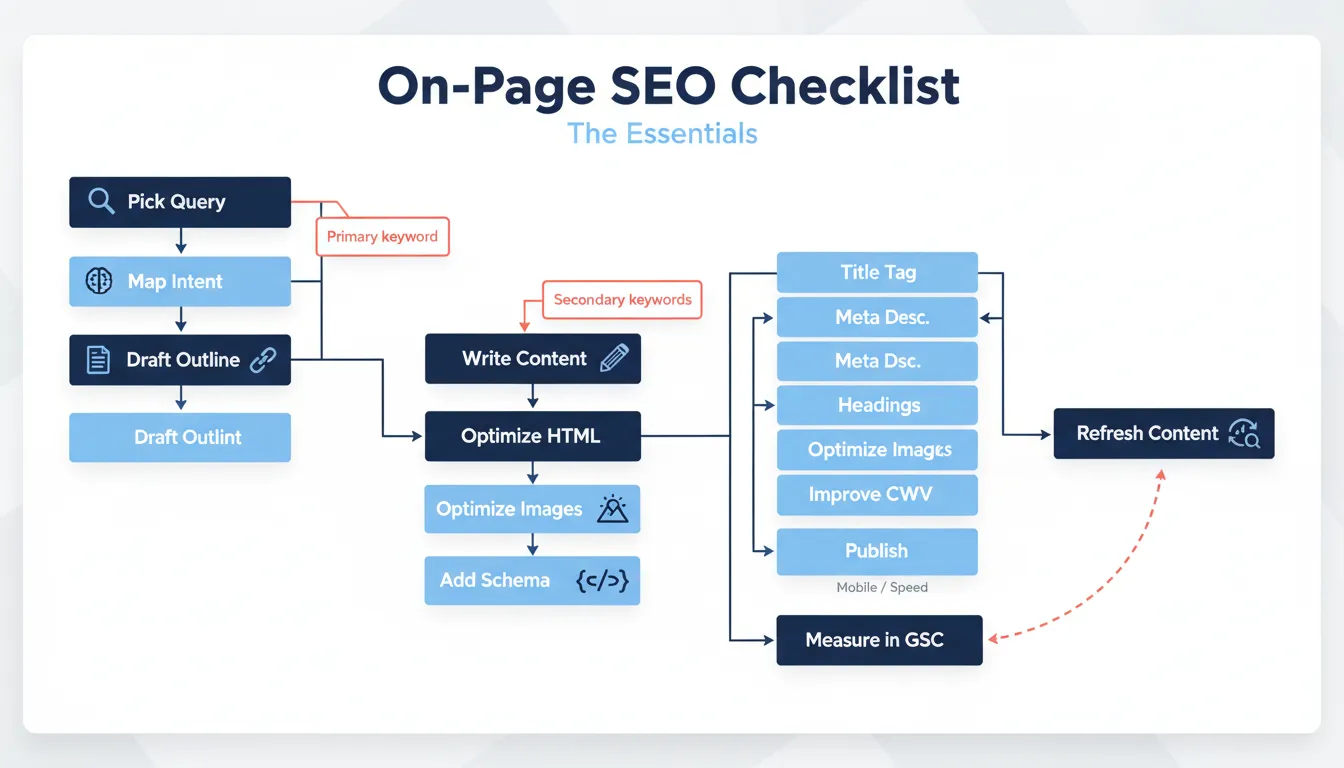
    Flowchart of a step-by-step on-page SEO workflow from intent research to publishing and refreshing.

    Write content that earns clicks, links, and engagement

    Once your metadata and structure are solid, content quality does most of the work. In competitive SERPs, “good enough” pages tend to stall.

    Cover the topic completely with a clear content brief

    Before writing, define:

    • The promise of the page (what you will help the reader do)
    • The scope (what you cover and what you won’t)
    • The proof you can include (examples, templates, screenshots, steps)

    If you need to scale consistent briefs, Supawriter can generate a long-form outline, align it to intent, and keep your brand voice consistent across pages.

    Use on-page SEO examples: opening, sections, and FAQs

    A practical on-page pattern that often works:

    • 2 to 3 sentence opening that restates the problem and outcome
    • A short “what it is” definition
    • A checklist or step-by-step process
    • Examples, templates, and common mistakes
    • A small FAQ section (only if it helps, not just to add words)

    Here’s a quick example of answer-first writing under a heading:

    • H2: What is on-page SEO?
    • First sentence: “On-page SEO is optimizing a specific webpage’s content and HTML so it can rank for relevant searches and earn clicks.”

    That first sentence should make sense on its own if it’s pulled into a snippet.

    Optimize images and media for SEO and accessibility

    Images can improve comprehension and time on page, but they also affect performance.

    Best practices:

    • Use descriptive filenames (not IMG_1234)
    • Add alt text that describes the image for accessibility
    • Compress images and serve modern formats when possible
    • Only add images that support the content (diagrams, annotated screenshots, comparisons)

    A simple way to keep this consistent is to standardize a media checklist for every page your team publishes.

    Here’s a quick table you can reuse in your workflow:

    On-page element What “good” looks like Common mistake
    Title tag Primary keyword near front, clear benefit Keyword stuffing or vague titles
    Meta description Specific promise, readable, matches intent Duplicated across pages
    Headings Descriptive H2s/H3s, answer-first sections “Getting started” headings everywhere
    Body content Complete coverage, examples, scannable Thin content that rehashes basics
    Images Compressed, descriptive alt text Huge files that slow the page
    Internal links Points to next step and related pages Random links with generic anchor text

    Optimize the page experience and technical elements

    This is where on-page overlaps with technical SEO. You don’t need to be a developer to improve many of these.

    Internal linking and topical clusters

    Internal links do two things:

    • Help users discover the next relevant page
    • Help Google understand relationships between pages

    A practical rule: every important page should link to 2 to 5 closely related pages, and those pages should link back where it makes sense.

    If you have related posts on your site, link them with descriptive anchors like “how to do keyword research for a single page” rather than “read more.”

    Core Web Vitals, mobile UX, and page speed basics

    Google’s Search Central documentation recommends focusing on “good” Core Web Vitals because they measure real-world user experience. The current thresholds it lists are:

    • LCP: aim for 2.5s or less
    • INP: aim for under 200ms
    • CLS: aim for 0.1 or less

    These are documented in Google’s “Understanding Core Web Vitals and Google search results” page. (Google Search Central Core Web Vitals)

    On-page actions that often help without deep engineering work:

    • Compress and properly size images
    • Reduce heavy embeds and unnecessary scripts
    • Use fewer large above-the-fold elements
    • Test on mobile and fix layout shifts

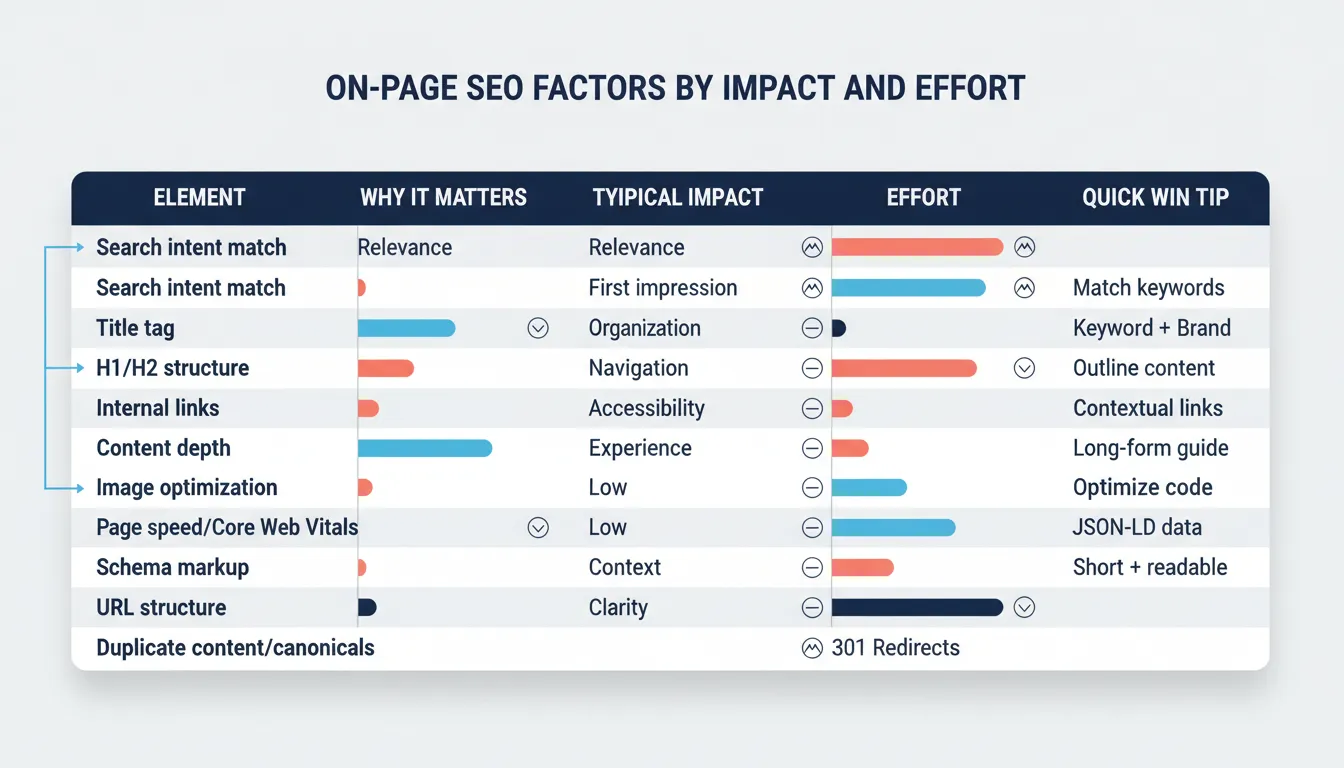
    Infographic comparing key on-page SEO factors by impact, effort, and quick-win tips.

    Schema markup and duplicate-content controls

    Schema markup can improve how your page is understood and displayed (especially for specific page types), but it should match the visible content.

    Also keep an eye on duplicate-content issues:

    • Avoid publishing multiple pages targeting the same keyword with the same angle
    • Use canonical tags when you legitimately have near-duplicates
    • Keep titles and meta descriptions unique per page

    If you’re publishing lots of content, consistency matters as much as individual optimizations. Supawriter can help teams keep standards consistent (structure, internal linking habits, and SEO fields) across dozens or hundreds of pages.

    Measure results and keep pages fresh

    On-page SEO isn’t set-and-forget. The pages that win usually go through multiple passes.

    Track what matters in Google Search Console

    For each important page, watch:

    • Queries and impressions (are you showing up for the right searches?)
    • Clicks and CTR (is your snippet earning the click?)
    • Average position (directionally useful, not a single source of truth)
    • Core Web Vitals and indexing reports (technical blockers)

    Run a 30-day refresh cycle

    A lightweight refresh loop:

    1. Week 1: Improve title and meta, and tighten the opening to match intent
    2. Week 2: Expand weak sections and add examples
    3. Week 3: Add 2 to 5 internal links and update outdated references
    4. Week 4: Re-check performance and prune what’s not helping

    Publishing cadence matters here. Consistent updates across a topic cluster can lift the whole cluster, not just one page.

    Common on-page SEO mistakes to avoid

    • Writing for keywords instead of solving the problem
    • Targeting too many keywords on one page (unclear relevance)
    • Using headings that don’t say anything
    • Duplicating titles and meta descriptions across pages
    • Adding internal links with generic anchor text
    • Ignoring mobile UX and performance until after rankings drop

    On-page SEO best practices are easy to list, but harder to do consistently across a whole site. If you want a system that helps you research, draft, optimize, and publish pages in a repeatable way, explore Supawriter and build a workflow you can keep up with.

  • Keyword Research for SEO in 2026: Step-by-Step Guide

    Keyword Research for SEO in 2026: Step-by-Step Guide

    Keyword research is the fastest way to stop guessing what to publish and start building pages you can actually rank. Done well, it’s not just a list of keywords. It’s a way to understand how people search, what they mean, and what Google is already rewarding.

    If you want to turn this into a repeatable publishing engine, Supawriter can help you go from keyword discovery to a fully optimized long-form draft and an auto-publishing workflow, while keeping everything aligned to your brand voice.

    What keyword research is and why it matters

    Keyword research vs keyword picking

    Keyword research is the process of discovering and evaluating the search queries (keywords) your audience uses, then choosing which ones you’ll target with specific pages.

    “Keyword picking” is the mistake most beginners make, you brainstorm a few ideas, pick the one that sounds right, and start writing. Keyword research adds the missing steps: expansion, validation, intent checks, and prioritization.

    Search intent in plain English

    Search intent is the reason behind a query. In practice, it answers: what does the searcher want to see right now?

    A simple intent model:

    • Informational: “how to do keyword research”, “what is keyword difficulty”
    • Commercial: “best keyword research tool”, “Ahrefs vs Semrush”
    • Transactional: “buy rank tracker”, “Semrush pricing”
    • Navigational: “Google Keyword Planner”, “Ahrefs keyword explorer”

    If you pick a keyword with the wrong intent for your page type, ranking gets harder even if the keyword looks perfect on paper.

    What success looks like for your site

    Before you open any tool, define success for the keyword set you’re building:

    • Traffic goal: more organic visits to your blog
    • Pipeline goal: more demo requests, trials, signups
    • Efficiency goal: fewer articles that go nowhere

    A helpful rule: the “best” keyword is the one that matches your audience and your offer, and that you can realistically compete for.

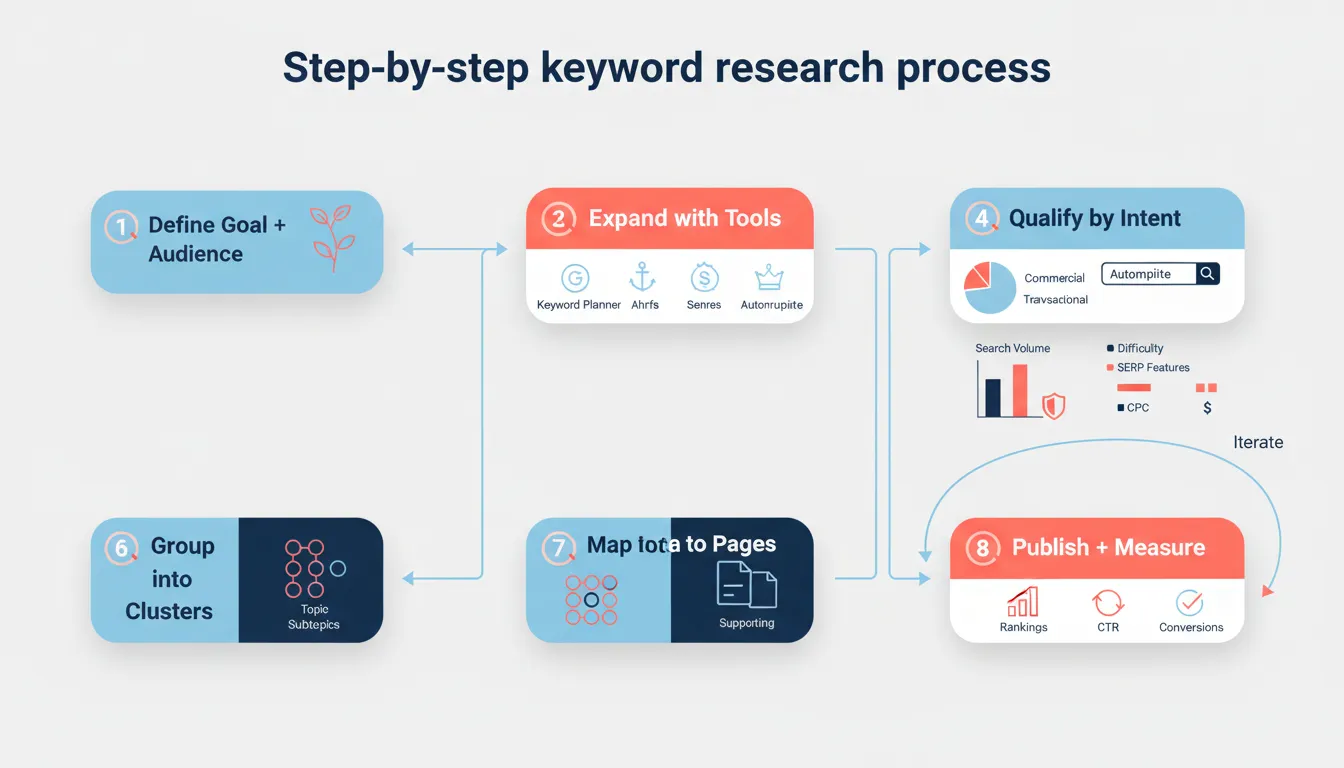
    Step-by-step keyword research process

    Start with seed keywords and audience pain points

    Seed keywords are the starting terms you feed into tools to generate thousands of related keywords. Ahrefs describes how tools use a seed keyword to expand into large keyword lists (Ahrefs keyword research guide).

    To build seeds quickly, answer these:

    • What do you sell, and what category words describe it?
    • What problems do customers describe in calls, support tickets, reviews?
    • What outcomes do they want?

    Example seed list for a SaaS content platform:

    • keyword research
    • SEO content
    • content calendar
    • internal linking
    • topic clusters

    Keep the list short. You’ll expand it next.

    Flowchart of the keyword research process from seed keywords to clustering, content creation, and iteration

    Expand your list with free and paid sources

    Use multiple sources because each one shows you different angles:

    Free expansion sources:

    • Google autocomplete and “People also ask”
    • Google Search Console (queries you already appear for)
    • Google Trends (seasonality and rising topics)
    • Google Ads Keyword Planner (ideas plus planning data)

    Paid expansion sources:

    • Ahrefs, Semrush, Moz, Mangools, SpyFu (databases, competitor data, difficulty scores)

    If you’re doing this inside a production workflow, Supawriter can speed up the middle part: discover keywords, find gaps, and turn prioritized clusters into consistent long-form articles that publish on schedule.

    Learn from competitors and SERPs

    Competitor research isn’t copying. It’s looking for patterns:

    • Which pages bring competitors their organic traffic?
    • Which topics do they cover repeatedly (and you don’t)?
    • Which formats does Google prefer for the query (guide, checklist, landing page)?

    A practical method:

    1. Search your seed keyword.
    2. Open the top 3 to 5 ranking pages.
    3. Note the page type, headings, tools mentioned, and subtopics repeated across pages.
    4. Add missing subtopics to your keyword list.

    This pulls what’s working in the SERP without turning your content into a clone.

    Choose the right keywords (metrics + intent)

    The core metrics to evaluate (volume, difficulty, CPC, trends)

    Most keyword tools give you some version of:

    • Search volume: average monthly searches
    • Difficulty / competition: how hard ranking tends to be
    • CPC: what advertisers pay (often a proxy for commercial value)
    • Trend/seasonality: whether demand is rising or shrinking

    HubSpot frames the beginner workflow as starting with a seed keyword, then checking search volume, keyword difficulty, and intent as key metrics (HubSpot keyword research article).

    Manually check the SERP before you commit

    Tool metrics are estimates. The SERP is reality.

    Before you choose a target keyword, check:

    • Are results mostly blog posts, product pages, or videos?
    • Are huge brands dominating, and do you have comparable authority?
    • Are there SERP features stealing clicks (featured snippets, videos, shopping)?
    • Do the top results actually answer the query well, or is there a gap?

    Often the best opportunity is a keyword where:

    • intent is clear
    • content quality in the top results is good but not great
    • you can add a useful angle (examples, templates, updated process, better UX)

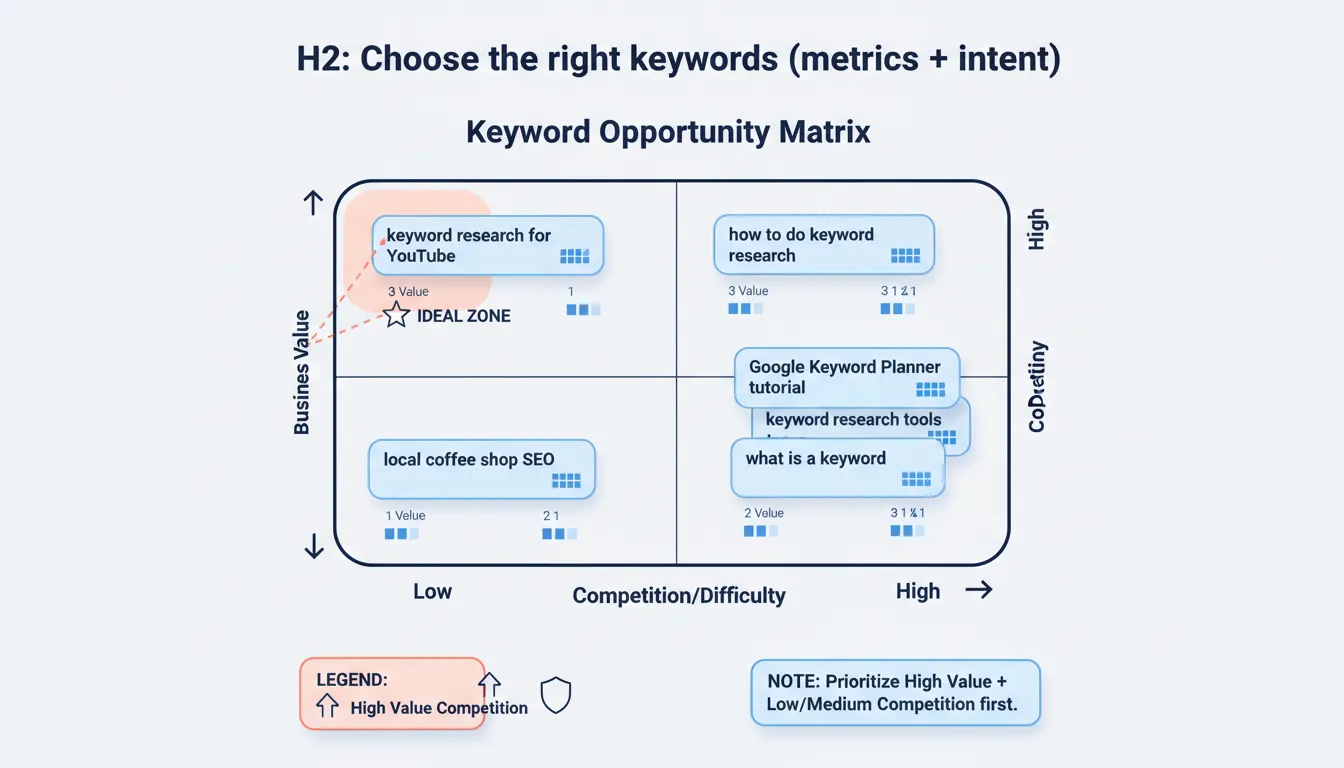
    Find your sweet spot with a simple prioritization model

    Use a lightweight scoring model so your list becomes a plan.

    One simple approach:

    • Business value (low, medium, high)
    • Competition (low, medium, high)

    Prioritize high value plus low or medium competition first.

    Keyword opportunity matrix comparing business value vs competition with example keyword bubbles

    Turn keywords into a content plan that ranks

    Cluster keywords by topic and intent

    A keyword cluster is a group of closely related keywords you can target with:

    • one main page (pillar)
    • several supporting pages (cluster content)

    Clustering prevents cannibalization (multiple pages fighting for the same keyword) and makes internal linking more natural.

    Example cluster:

    • Pillar: keyword research
    • Supporting:
      • keyword research examples
      • keyword research for SEO
      • keyword research for blog
      • keyword research for free
      • Google Keyword Planner tutorial

    Map keywords to pages (pillar, supporting, product)

    Treat keywords as an information architecture exercise:

    • Pillar page: broad, high-intent topic (“keyword research”)
    • Supporting posts: narrower subtopics (“keyword research for YouTube”)
    • Product pages: transactional and feature-driven (“SEO content automation platform”)

    Once you have this mapped, your on-page execution matters a lot. If you want a checklist that pairs well with this stage, use on-page SEO best practices for 2026 while you draft and optimize.

    Write briefs that make ranking more likely

    Before writing, create a one-page brief per target keyword:

    • primary keyword plus 3 to 6 secondary keywords
    • search intent (what the SERP expects)
    • required sections (based on common headings in top results)
    • unique angle (what you’ll add that others don’t)
    • internal links to include

    This is where Supawriter helps teams: it can turn your brief into a consistent long-form article in your brand voice, optimize for SEO fundamentals, and keep a predictable publishing cadence.

    Examples and templates you can copy

    Keyword research examples for SEO and blog content

    Here are a few solid keyword choices depending on your situation:

    • New site: “keyword research for blog” (more specific intent, often less competitive)
    • Tool-led post: “Google Keyword Planner tutorial” (clear how-to intent)
    • Commercial comparison: “best keyword research tool” (high value, often more competitive)

    A good next step is to pick one primary keyword per page, then support it with closely related secondary keywords instead of cramming everything into one article.

    Keyword research for Google Ads vs SEO

    SEO keyword research and Google Ads keyword research overlap, but the decision criteria differ:

    • SEO: intent match, content depth, backlinks/authority, long-term traffic
    • Ads: cost, conversion rate, landing page relevance, budget forecasts

    Google Ads Keyword Planner is designed for planning campaigns, and Google’s documentation highlights using “Discover new keywords” and building a keyword plan inside the tool (Google Keyword Planner overview).

    Zapier’s review also notes Keyword Planner’s forecasting and budget planning strengths, and that it’s free (Zapier free keyword tool roundup).

    A simple keyword spreadsheet template

    You don’t need a fancy system to start. Use a sheet with these columns and score consistently.

    Cluster Primary keyword Secondary keywords Intent Volume (est.) Difficulty (est.) CPC (est.) Business value (1-5) Priority (Now/Next/Later) Target page Notes
    Keyword research keyword research keyword research for SEO, keyword research examples Informational /blog/keyword-research Pillar guide
    Keyword research Google Keyword Planner keyword planner tutorial, discover new keywords Informational/Commercial /blog/google-keyword-planner Include screenshots
    Content ops content calendar for SEO SEO calendar, editorial calendar Informational /blog/seo-content-calendar Tie to workflow

    Fill in the metric estimates from your tool of choice, then sort by Priority.

    If you want to go from spreadsheet to publishing without adding more process overhead, Supawriter can take your prioritized clusters, generate SEO-focused long-form articles in your voice, and auto-publish them to an embeddable blog that works with your existing site. That way, keyword research turns into execution instead of a backlog.