
Topical authority is the reputation your website earns for a specific subject. When you consistently publish helpful content that covers a topic from multiple angles, Google is more likely to treat your site as a credible resource for related searches.
If you're building a B2B SaaS blog, topical authority is the difference between publishing random posts that never compound and building a connected library that keeps ranking over time. Achieving that kind of compounding growth is much easier with Supawriter, because research, writing, optimization, internal linking, and publishing can run as one system instead of a pile of one-off tasks.
what topical authority is (and what it isn't)
definition in plain English
Topical authority (in SEO) is how strongly search engines associate your website with expertise and usefulness on a particular topic.
That's why so many high-ranking guides talk about "depth and breadth" of coverage, you don't just have one good page, you have a network of pages that answers the real questions people ask around that subject.
Two clarifications:
- There isn't a single public "topical authority score" from Google. It's something you infer from performance, for example, more rankings across a cluster, faster indexing, better stability, and more internal pages ranking.
- Tools can estimate topical relevance, but they're approximations. Semrush describes its "Topical Authority" as a proprietary metric that indicates how relevant a domain is to the topic of a seed keyword. That's useful directionally, but it isn't Google's internal measure. (Semrush explanation)
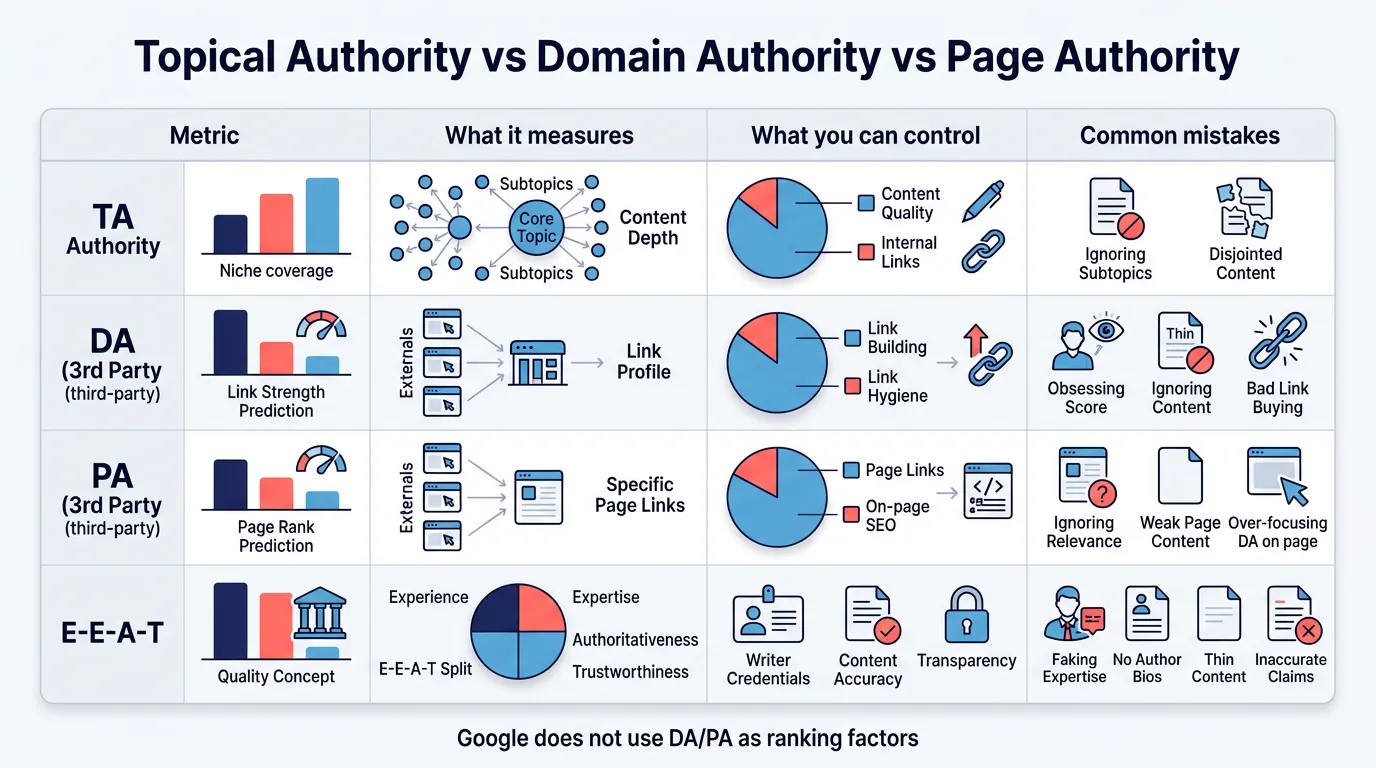
topical authority vs domain authority vs E-E-A-T
Topical authority is often lumped together with a few related concepts:
- Domain authority (DA) / page authority (PA): third-party metrics meant to predict ranking ability. They're useful for rough comparisons, but they're not Google ranking factors.
- E-E-A-T: a quality concept from Google's Search Quality Rater Guidelines that stands for Experience, Expertise, Authoritativeness, and Trust. Google notes that E-E-A-T itself isn't a single ranking factor, but its systems aim to surface content that looks most helpful and trustworthy, especially for sensitive topics. (Google on E-E-A-T)
In practice, topical authority is one of the clearer ways to demonstrate E-E-A-T at scale: your site keeps answering the topic well, shows real experience where it matters, cites sources when needed, and stays current.
why topical authority matters more as search gets more semantic
Search has shifted from matching exact keywords to understanding meaning. Search engines increasingly look at whether a site covers a topic thoroughly and connects related concepts clearly, which is why "semantic depth" and entity coverage come up so often in SEO discussions. (Search Engine Land on semantic depth)
The takeaway: topical authority isn't a trick. It usually comes from building a site that helps users learn and decide.
how topical authority works (how Google connects the dots)
breadth vs depth: the two levers you control
A simple way to think about topical authority is a T-shape:
- Breadth: you cover the major subtopics and common questions.
- Depth: you go beyond basics on the subtopics that matter most, with examples, steps, and clear explanations.
If you only do breadth, your content stays shallow. If you only do depth on one page, you look like a one-hit wonder. Authority builds when both accumulate over time.
topic clusters, entities, and internal links
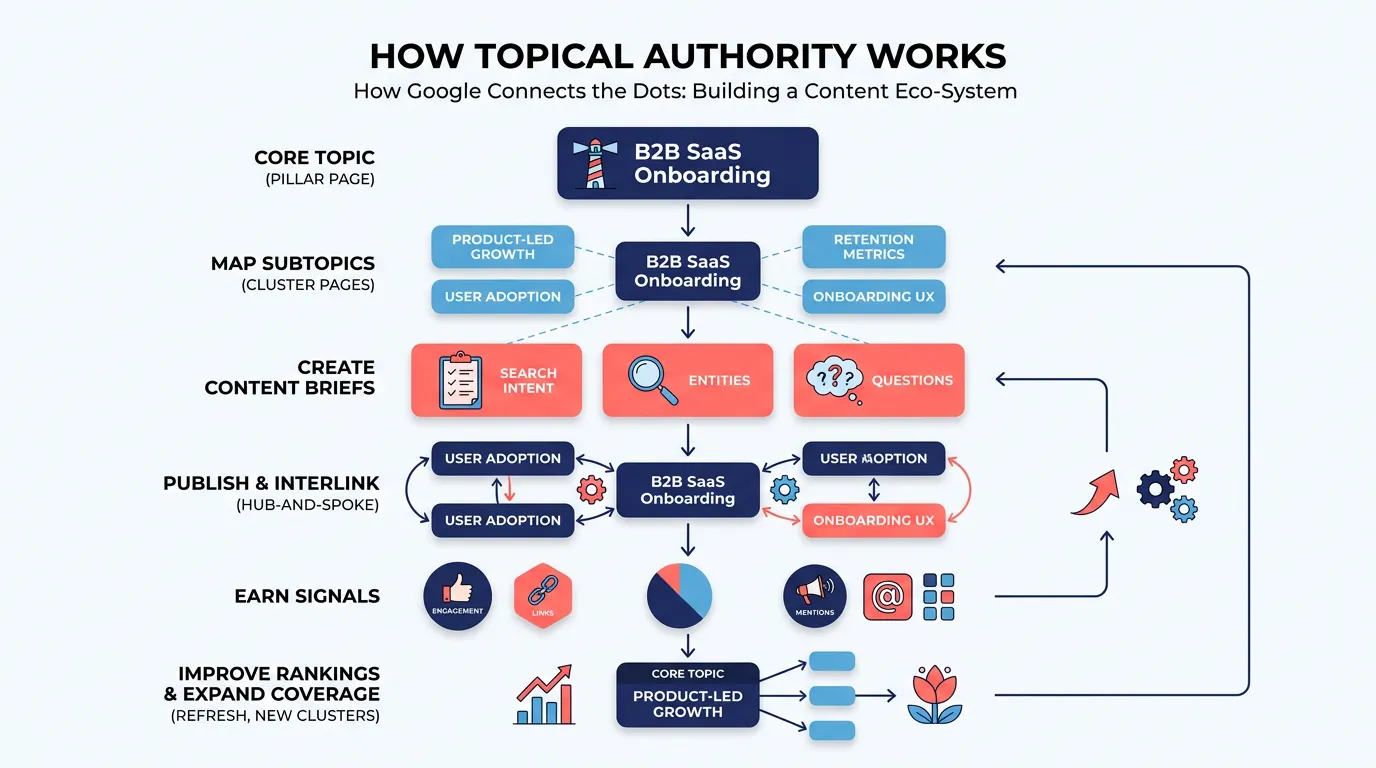
Most sites build topical authority through a pillar and cluster model:
- A pillar page targets the broad topic and acts as the hub.
- Cluster pages target subtopics and specific intents (definitions, comparisons, how-tos, templates, troubleshooting).
- Internal links connect the hub to spokes and spokes to each other, so both users and search engines can understand relationships.
This is also where entities matter. A strong topical cluster naturally mentions and explains the key things that define a topic (concepts, processes, tools, frameworks), not just keyword variations.
the signals that often move alongside authority
You can't control Google's internal evaluation directly, but you can control inputs that often line up with topical authority growth:
- More pages ranking for related queries (not just one head term)
- More impressions across long-tail searches
- Better internal link discovery (fewer orphan pages)
- More natural backlinks and mentions as your content becomes a common reference
- More stable rankings because you've covered the topic more completely
Ahrefs also frames topical authority as becoming a go-to resource on a topic, and notes that creating lots of relevant content enables more internal linking and can earn more natural backlinks over time. (Ahrefs guide)
a practical example of topical authority (B2B SaaS)
pick a core topic and draw the cluster map
Let's say your SaaS sells a product analytics platform. A core topic you could try to own is product analytics.
A cluster map could include subtopics like:
- event tracking
- product KPIs (activation, retention, expansion)
- cohort analysis
- funnels
- instrumentation plans
- data governance
- privacy and consent
- analytics for PLG teams
build pillar and supporting pages by intent
To build authority faster, don't publish ten definitions in a row. Mix intent:
- Definition: "What is product analytics?"
- How-to: "How to build an instrumentation plan"
- Template: "Instrumentation plan template (with examples)"
- Comparison: "Product analytics vs web analytics"
- Problem-solving: "Why your funnel conversion rate is misleading"
That variety matters because people enter from different searches, but they still want a clear path to the rest of the topic.
When it comes to turning that map into publish-ready content consistently, Supawriter offers an end-to-end workflow: topic research, long-form drafts, on-page SEO optimization, contextual internal linking suggestions, and scheduling so clusters get built deliberately.
interlinking rules that make the cluster coherent
Use simple rules you can apply every time:
- Every cluster page links back to the pillar with a descriptive anchor.
- The pillar links out to every cluster page.
- Cluster pages cross-link when it actually helps the reader (for example, "cohort analysis" should link to "retention metrics").
- Avoid generic anchors like "click here." Use anchors that describe what's on the page.
If you want tooling ideas for scaling this, you can also reference our guide to internal linking tools in 2026.
how to build topical authority step by step
step 1: choose a focused topic you can own
Most sites fail here by picking something too broad.
Good: "B2B onboarding emails," "SOC 2 compliance for SaaS," "product-led growth metrics."
Too broad: "marketing," "security," "SaaS."
A practical filter is: can you realistically publish 20 to 50 high-quality pages around this topic within 3 to 6 months? If not, narrow the scope.
step 2: do topic-first research, not keyword-only research
Keyword research still matters, but topical authority comes from understanding the space:
- core definitions and sub-definitions
- common "how do I" questions
- comparisons and alternatives
- frameworks and checklists
- mistakes and troubleshooting
- tools and workflows
You can turn this into a repeatable process by building a topic brief that includes:
- primary intent (learn, compare, do)
- related entities to cover
- must-answer questions
- internal links to include
step 3: publish, link, refresh, and expand on a schedule
Topical authority compounds when your publishing is structured:
- Publish the pillar (or a "minimum viable pillar") early.
- Publish 6 to 10 cluster pages that cover the most searched subtopics.
- Add internal links immediately as new pages go live.
- Refresh pages that start gaining impressions but not clicks.
- Expand with adjacent subclusters.
Supawriter helps teams keep that cadence without sacrificing quality. It can help you research, draft 2,500+ word articles, optimize on-page SEO, and maintain a publishing schedule so your cluster grows in a planned sequence.
how to measure topical authority (without chasing vanity metrics)
what to track in Google Search Console
In Google Search Console (GSC), topical authority shows up as patterns across a topic cluster, not a single keyword win.
Track:
- Total impressions for pages in the cluster
- Number of queries those pages appear for
- Average position trends across the cluster
- Pages indexed and "discovered" rate
- CTR improvements after title and snippet updates
A simple approach is to create a GSC page filter that includes your cluster URL path (for example, /product-analytics/) and monitor performance as a group.
using third-party "topical authority" checkers the right way
Third-party metrics can help if you use them as diagnostics, not goals.
Here's a practical interpretation table:
| Tool output | What it usually means | What to do next |
|---|---|---|
| High relevance, low rankings | You're thematically aligned but underpowered | Improve internal links, expand missing subtopics, earn a few relevant links |
| Moderate relevance | Partial coverage or unclear positioning | Build the cluster deeper, tighten intent targeting |
| Low relevance | Topic mismatch | Choose a narrower topic or create a dedicated section/subdirectory |
Semrush, for example, explains its Topical Authority as a proprietary algorithm that compares a domain's thematics with a keyword and categorizes relevance from low to high. Use that to spot misalignment and content gaps, not as a promise of top rankings. (Semrush metric details)
common pitfalls that prevent authority from compounding
These issues stop topical authority from building even when you publish a lot:
- Orphan pages (no internal links in or out)
- Inconsistent intent (a page tries to be definition, comparison, and how-to all at once)
- Thin coverage (you skip the obvious questions users need answered)
- Cannibalization (multiple pages targeting the same subtopic without differentiation)
- No refresh loop (older pages decay and drag down the cluster)
If you want one guiding principle, use Google's "helpful, reliable, people-first" framing: create content that demonstrates experience and earns trust, and structure it so users can navigate the topic end to end. (Google guidance)
Topical authority is ultimately a content system problem: planning, coverage, interlinking, and consistent publishing. If you want that system to run with less manual effort, explore how Supawriter can research your topic, produce on-brand long-form content, optimize it for SEO, and publish clusters that actually compound into authority over time.