If you want more traffic from Google without waiting on backlinks or a site redesign, on-page SEO is usually where you get the fastest compounding wins. It’s the work you do on a single page to help search engines understand it, help users trust it, and help it work well on mobile.
A consistent process gets easier with Supawriter: you can generate long-form pages in your brand voice, get built-in SEO help (meta tags, internal linking suggestions, structure), and publish on a schedule without turning your team into a content factory.
What on-page SEO is and what it includes in 2026
On-page SEO is optimizing a webpage’s content and HTML elements so it can rank for relevant searches and earn clicks once it shows up. In 2026, the definition hasn’t changed much, but expectations have: pages need to match intent, be easy to scan, and load and behave well.
On-page vs. technical vs. off-page SEO
- On-page SEO: what’s on the page (content, headings, title tag, internal links, images, schema on that URL).
- Technical SEO: sitewide foundations (crawlability, indexing, rendering, site architecture, performance tooling).
- Off-page SEO: signals outside your site (links, mentions, brand demand).
They overlap, but when you’re improving one specific URL, your biggest levers are usually on-page.
What’s changed in 2026: intent, UX, and AI visibility
Search results aren’t just 10 blue links anymore. Google shows more rich features, and AI tools pull sections of pages to answer questions. Clear structure and self-contained answers make it easier for both people and machines to use your content.
Semrush notes that on-page SEO now includes improving visibility in search results and in responses from large language model tools, by using clear headings, internal links, and strong page experience. (Semrush on-page SEO guide)
The 80/20: fixes that usually move rankings fastest
If you only have time for a few improvements, start here:
- Match intent (your page must solve the problem the query implies)
- Upgrade the title tag (better relevance and CTR)
- Fix heading structure (scannable sections that answer questions)
- Strengthen internal links (help Google and users discover related pages)
- Improve page experience basics (mobile usability and Core Web Vitals)
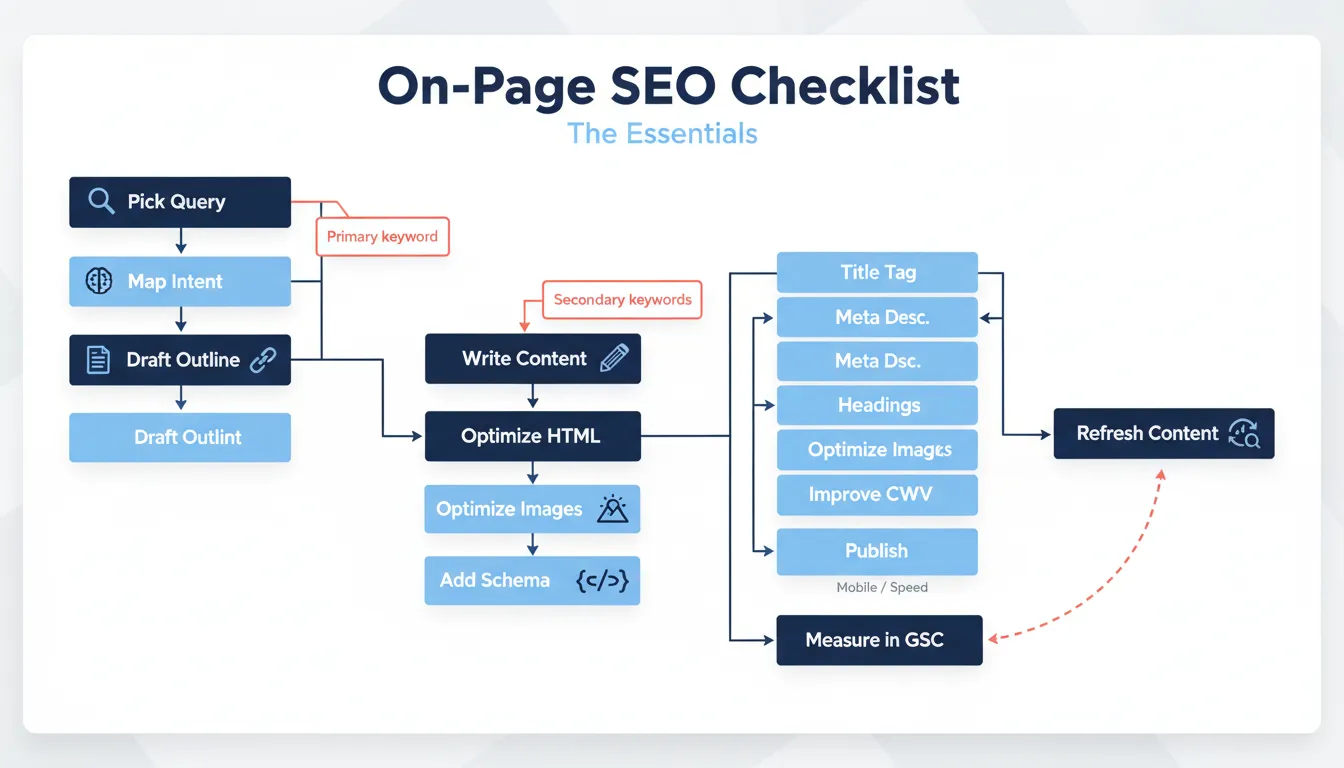
On-page SEO checklist (the essentials)
Use this checklist every time you publish a new page or refresh an existing one.
Pick one primary keyword and map search intent
Pick one primary keyword per page and write the page to satisfy that query. Then add a small set of closely related secondary terms that naturally fit your sections.
A quick intent test:
- If the SERP is mostly guides, your page should be educational and comprehensive.
- If it’s mostly product pages, your page should be transactional and comparison-friendly.
- If it’s mostly category pages, you’re probably targeting the wrong format.
If you’re building at scale, Supawriter can turn a keyword into a structured brief (sections, angle, and supporting terms) so your content lines up with what the SERP rewards.
Optimize title tag, meta description, and URL
Title tag best practices (2026):
- Put the primary keyword near the start
- Make it descriptive (avoid vague titles like “Ultimate Guide” without context)
- Keep it short enough to reduce truncation (many SEO guides recommend roughly the 50 to 60 character zone, depending on pixels and device) (Semrush meta tags guide)
Meta description best practices:
- Write it like ad copy: benefit + proof + next step
- Include the keyword once, naturally
- Keep it concise (Google may rewrite it anyway, but you still want a strong default)
You’ll see different length advice across the industry. Some guides aim shorter to avoid truncation; others aim for the more traditional 150 to 160 character range. Use a character counter and prioritize clarity over hitting a perfect number.
URL best practices:
- Keep it readable and descriptive
- Use hyphens, not underscores
- Remove filler words where possible
Example for this topic:
- Title tag: On-page SEO best practices for 2026: practical checklist
- Meta description: On-page SEO best practices for 2026: optimize titles, headings, content, links, images, and Core Web Vitals with a simple checklist.
- URL: /on-page-seo-best-practices
Structure headings for skimmability and extractable answers
Heading structure helps users scan, and it helps machines pull clean sections.
Basic rules:
- Use one H1 for the page topic
- Use H2s for the main sections
- Use H3s for subpoints under each H2
- Make headings specific (turn vague headings into descriptive ones)
Write content that earns clicks, links, and engagement
Once your metadata and structure are solid, content quality does most of the work. In competitive SERPs, “good enough” pages tend to stall.
Cover the topic completely with a clear content brief
Before writing, define:
- The promise of the page (what you will help the reader do)
- The scope (what you cover and what you won’t)
- The proof you can include (examples, templates, screenshots, steps)
If you need to scale consistent briefs, Supawriter can generate a long-form outline, align it to intent, and keep your brand voice consistent across pages.
Use on-page SEO examples: opening, sections, and FAQs
A practical on-page pattern that often works:
- 2 to 3 sentence opening that restates the problem and outcome
- A short “what it is” definition
- A checklist or step-by-step process
- Examples, templates, and common mistakes
- A small FAQ section (only if it helps, not just to add words)
Here’s a quick example of answer-first writing under a heading:
- H2: What is on-page SEO?
- First sentence: “On-page SEO is optimizing a specific webpage’s content and HTML so it can rank for relevant searches and earn clicks.”
That first sentence should make sense on its own if it’s pulled into a snippet.
Optimize images and media for SEO and accessibility
Images can improve comprehension and time on page, but they also affect performance.
Best practices:
- Use descriptive filenames (not IMG_1234)
- Add alt text that describes the image for accessibility
- Compress images and serve modern formats when possible
- Only add images that support the content (diagrams, annotated screenshots, comparisons)
A simple way to keep this consistent is to standardize a media checklist for every page your team publishes.
Here’s a quick table you can reuse in your workflow:
| On-page element | What “good” looks like | Common mistake |
|---|---|---|
| Title tag | Primary keyword near front, clear benefit | Keyword stuffing or vague titles |
| Meta description | Specific promise, readable, matches intent | Duplicated across pages |
| Headings | Descriptive H2s/H3s, answer-first sections | “Getting started” headings everywhere |
| Body content | Complete coverage, examples, scannable | Thin content that rehashes basics |
| Images | Compressed, descriptive alt text | Huge files that slow the page |
| Internal links | Points to next step and related pages | Random links with generic anchor text |
Optimize the page experience and technical elements
This is where on-page overlaps with technical SEO. You don’t need to be a developer to improve many of these.
Internal linking and topical clusters
Internal links do two things:
- Help users discover the next relevant page
- Help Google understand relationships between pages
A practical rule: every important page should link to 2 to 5 closely related pages, and those pages should link back where it makes sense.
If you have related posts on your site, link them with descriptive anchors like “how to do keyword research for a single page” rather than “read more.”
Core Web Vitals, mobile UX, and page speed basics
Google’s Search Central documentation recommends focusing on “good” Core Web Vitals because they measure real-world user experience. The current thresholds it lists are:
- LCP: aim for 2.5s or less
- INP: aim for under 200ms
- CLS: aim for 0.1 or less
These are documented in Google’s “Understanding Core Web Vitals and Google search results” page. (Google Search Central Core Web Vitals)
On-page actions that often help without deep engineering work:
- Compress and properly size images
- Reduce heavy embeds and unnecessary scripts
- Use fewer large above-the-fold elements
- Test on mobile and fix layout shifts
Schema markup and duplicate-content controls
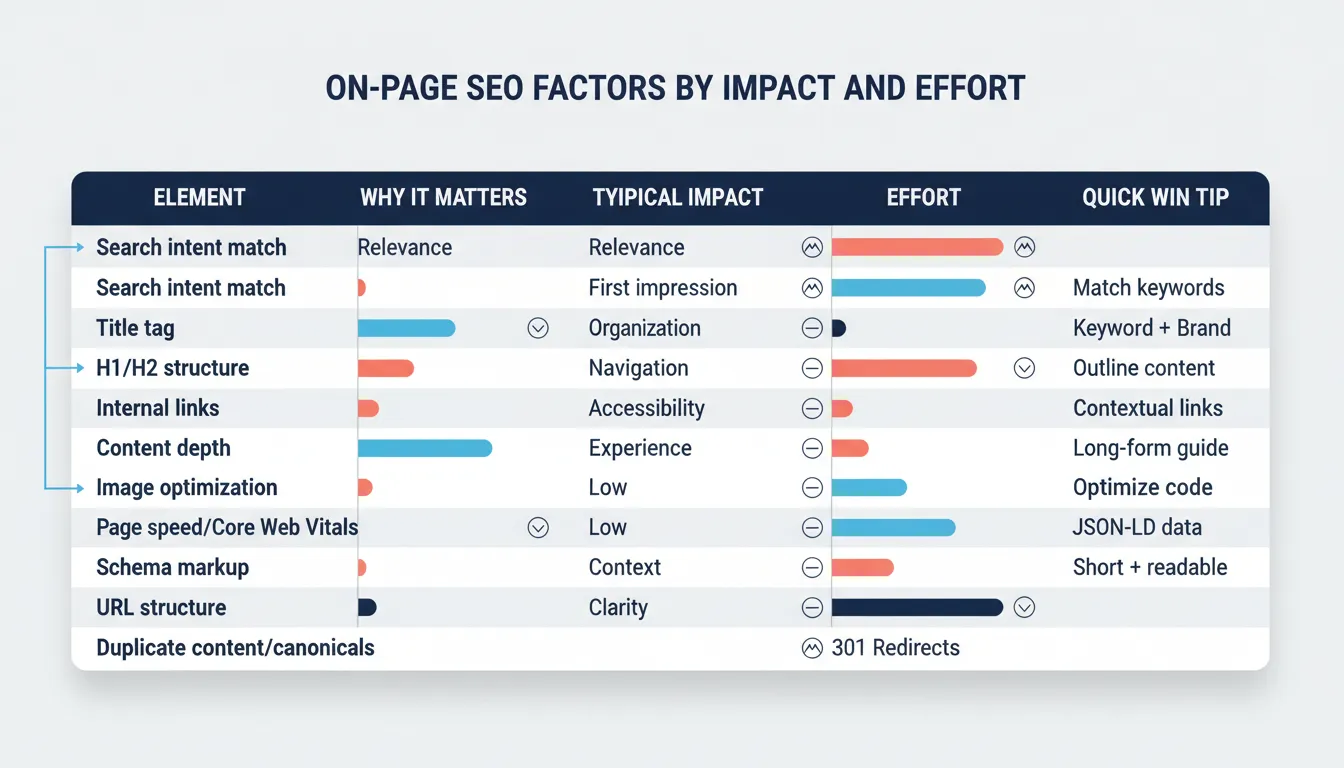
Schema markup can improve how your page is understood and displayed (especially for specific page types), but it should match the visible content.
Also keep an eye on duplicate-content issues:
- Avoid publishing multiple pages targeting the same keyword with the same angle
- Use canonical tags when you legitimately have near-duplicates
- Keep titles and meta descriptions unique per page
If you’re publishing lots of content, consistency matters as much as individual optimizations. Supawriter can help teams keep standards consistent (structure, internal linking habits, and SEO fields) across dozens or hundreds of pages.
Measure results and keep pages fresh
On-page SEO isn’t set-and-forget. The pages that win usually go through multiple passes.
Track what matters in Google Search Console
For each important page, watch:
- Queries and impressions (are you showing up for the right searches?)
- Clicks and CTR (is your snippet earning the click?)
- Average position (directionally useful, not a single source of truth)
- Core Web Vitals and indexing reports (technical blockers)
Run a 30-day refresh cycle
A lightweight refresh loop:
- Week 1: Improve title and meta, and tighten the opening to match intent
- Week 2: Expand weak sections and add examples
- Week 3: Add 2 to 5 internal links and update outdated references
- Week 4: Re-check performance and prune what’s not helping
Publishing cadence matters here. Consistent updates across a topic cluster can lift the whole cluster, not just one page.
Common on-page SEO mistakes to avoid
- Writing for keywords instead of solving the problem
- Targeting too many keywords on one page (unclear relevance)
- Using headings that don’t say anything
- Duplicating titles and meta descriptions across pages
- Adding internal links with generic anchor text
- Ignoring mobile UX and performance until after rankings drop
On-page SEO best practices are easy to list, but harder to do consistently across a whole site. If you want a system that helps you research, draft, optimize, and publish pages in a repeatable way, explore Supawriter and build a workflow you can keep up with.